Retatrutide Eases Sleep Apnea in Two Phase III Trials
Retatrutide, an experimental triple agonist that targets GIP, GLP-1 and glucagon receptors, improved obstructive sleep apnea in adults with obesity or overweight, according to two parallel randomized trials. The results were presented at the Congress of the European Sleep Research Society and published in the New England Journal of Medicine. Researchers found effects similar to those seen with tirzepatide, the first drug approved to treat sleep apnea, though the trials did not directly compare the two medications.
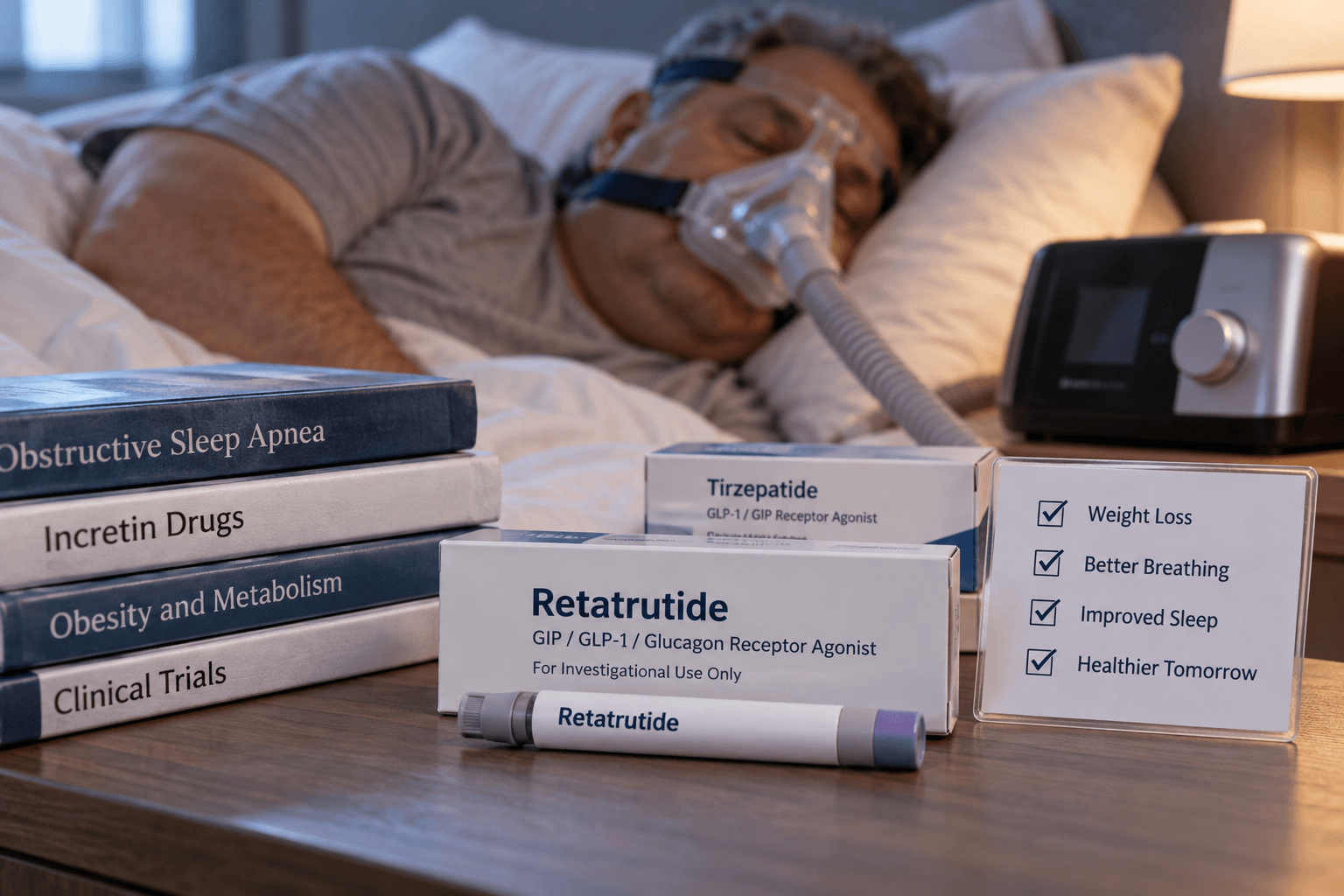
- Retatrutide improved obstructive sleep apnea in adults with obesity or overweight, with or without type 2 diabetes.
- AHI dropped 24.4 to 21.9 events per hour more than placebo in trials of participants without diabetes, and 14.4 to 15.1 in those with diabetes.
- Body weight loss ranged from 12.1% to 22.2%, compared with 4.8% to 5.6% on placebo.
- Results looked similar to tirzepatide (Zepbound), the first drug approved for sleep apnea in 2024.
- Experts said the trials did not show retatrutide is superior to tirzepatide.
- Remission rates reached as high as 51.6% in the middle-dose group, compared with 12.5% on placebo.
- The most common side effects were gastrointestinal, similar to other TRIUMPH trials.
- CPAP remains the gold standard, but not everyone can tolerate it, which is why more options are welcome.
Another incretin-based drug is showing it can make a real difference for people with obstructive sleep apnea. Two parallel randomized clinical trials found that retatrutide, an experimental triple agonist that targets the glucose-dependent insulinotropic polypeptide (GIP), glucagon-like peptide 1 (GLP-1) and glucagon receptors, improved sleep apnea in adults with obesity or overweight, whether or not they had type 2 diabetes.
The research was led by Ronald Grunstein, MD, PhD, of the Woolcock Institute of Medical Research at Macquarie University in Sydney. His team published the findings in the New England Journal of Medicine and presented them at the Congress of the European Sleep Research Society in Maastricht, the Netherlands.
If you're new to the topic, here's the basic idea. Obstructive sleep apnea happens when the airway repeatedly collapses during sleep, causing pauses in breathing. Doctors measure how severe it is with the apnea-hypopnea index (AHI), which counts how many breathing disruptions occur each hour. Continuous positive airway pressure, or CPAP, has long been the gold standard for treatment. The catch is that not everyone can tolerate it, which is why researchers are looking for other options.
Does retatrutide help treat sleep apnea?
In the TRIUMPH-1-OSA trial, which excluded people with type 2 diabetes, the AHI dropped by 24.4 and 21.9 events per hour more than placebo at 80 weeks for the 9 mg and 12 mg doses, respectively. In TRIUMPH-2-OSA, which included people with type 2 diabetes, the reductions were 14.4 and 15.1 events per hour more than placebo at the same doses. All of these differences met statistical significance on the primary endpoint.
Weight loss played a major role. Mean body weight loss ranged from 12.5% to 22.2% in TRIUMPH-1-OSA and from 12.1% to 18.5% in TRIUMPH-2-OSA. Participants on placebo lost 4.8% and 5.6%, respectively. The researchers noted that these effects were similar to those associated with this degree of weight loss in earlier studies of other treatments.
How does retatrutide compare with tirzepatide for sleep apnea?
That comparison matters because tirzepatide, sold as Zepbound, became the first drug approved to treat sleep apnea in 2024. In the SURMOUNT-OSA trials, tirzepatide reduced AHI by 20.0 to 23.8 events per hour more than placebo at 52 weeks, with body weight reductions of 17.7% to 19.6%. Retatrutide's results looked broadly comparable.
Mariam Louis, MD, of the University of Florida in Jacksonville and incoming chair of the CHEST Sleep Medicine Network, said she expected the extra action of a third receptor to produce bigger weight loss and a larger drop in AHI. That didn't happen. "I don't think we can say that it is superior to the tirzepatide, but it certainly, based on this particular study, produced very similar results," she said.
Hoi Yee Kwan, MBChB, chief of respiratory medicine at Kowloon Hospital in Hong Kong, who was not involved in the trials, said more treatment options would be a good thing for patients. She also pointed out a gap. In the retatrutide trials, the share of patients whose AHI fell below 5 events per hour was lower than she would like. "Because our aim is to bring the OSA back to normal, which is something that we could have achieved with CPAP, which is the target for us to achieve," Kwan said.
Remission rates, defined as an AHI under 5 or an AHI of 5 to 14 with an Epworth Sleepiness Scale score of 10 or lower, offer more detail. In TRIUMPH-1-OSA, remission reached 26.3% in the lowest-dose group, 51.6% in the middle-dose group, 42.3% in the highest-dose group and 12.5% in the placebo group. In TRIUMPH-2-OSA, the figures were 24.3%, 39.5%, 38.9% and 12.6%, respectively.
The trials enrolled 243 participants in TRIUMPH-1-OSA and 448 in TRIUMPH-2-OSA. Both included adults with moderate-to-severe sleep apnea, defined as an AHI of at least 15 per hour, and a body mass index of at least 27. Participants were randomly assigned to once-weekly subcutaneous retatrutide at 4, 9 or 12 mg, or to placebo. Unlike the SURMOUNT-OSA trials, both TRIUMPH-OSA studies included people who could not or would not use PAP therapy, as well as people who had used it for at least three consecutive months but stopped for the trial. That group made up about 30% of participants.
Safety looked similar to what was seen across the broader TRIUMPH program, with gastrointestinal events being the most common side effects. Louis also suggested that a switching option could help people who don't respond to a first-generation GLP-1 medication such as semaglutide. "If they didn't lose weight with, for example, the first generation GLP-1, maybe they'll have better success with this one," she said.
Is retatrutide available for sleep apnea treatment?
Retatrutide is still investigational, so these results don't mean it is available for sleep apnea treatment today. For now, the findings add weight to a growing body of evidence that incretin-based drugs can do more than help with weight, and that the next few years could bring more choices for people who struggle with CPAP.
FAQ
- Does retatrutide reduce sleep apnea severity?
- Yes. In two Phase III trials, it lowered the apnea-hypopnea index by 14.4 to 24.4 events per hour more than placebo at 80 weeks, depending on the trial and dose.
- Is retatrutide approved to treat sleep apnea?
- No. Retatrutide is still investigational, so it is not available for sleep apnea treatment today.
- Were people with type 2 diabetes included in the retatrutide sleep apnea trials?
- People with type 2 diabetes were excluded from TRIUMPH-1-OSA but included in TRIUMPH-2-OSA.
Read next
Eli Lilly's Obesity Drug Shows Promise, But Heart Benefits Remain Unclear
Eli Lilly's new obesity drug, retatrutide, has been shown to be highly effective in weight loss, with participants losing 22.6% of their weight after 80 weeks. However, the drug's impact on cardiovascular risk remains unclear due to a lack of statistically significant results in a recent Phase 3 study.

Two Deaths Linked to Counterfeit Retatrutide; Novo Nordisk to Drop Saxenda
Two recent deaths tied to counterfeit versions of retatrutide, an investigational weight-loss medication, have been reported to the Food and Drug Administration. The reports come as lawsuits against GLP-1 drugs continue, and as Novo Nordisk announced plans to discontinue its weight-loss injectable Saxenda in early 2027 because of declining sales. The World Health Organization also issued its first obesity guidelines for children and adolescents, and researchers released new findings on diabetes, dementia risk in women with PMOS, and a range of other conditions.
Desperate for Weight Loss, People Turn to Unapproved Retatrutide
Retatrutide, a promising weight-loss drug not yet approved by the FDA, is being sought after by people dissatisfied with current medications, with some turning to the gray market to purchase it, despite warnings from doctors about the risks to their health.
Eli Lilly Grants Access to Experimental Obesity Drug to 79-Year-Old Patient
Eli Lilly has given a 79-year-old patient access to its experimental obesity drug, retatrutide, through the FDA's compassionate use program. The move has raised eyebrows, with sources suggesting the patient may be well-connected. Retatrutide has shown promising results, with weight loss comparable to bariatric surgery.
GLP-1 Medications Show Promise in Treating Obesity and Improving Fertility
Research on GLP-1 medications has yielded promising results in treating obesity and improving fertility in men with low testosterone. A study found that GLP-1s may improve testosterone levels and sperm quality, while another study showed a 310-fold increase in GLP-1 prescriptions for children with obesity.