Retatrutide Is One Click Away, but That Does Not Make It Safe
Retatrutide, an investigational weight-loss and diabetes drug, is being sold online as a “research” product even though it has no FDA approval for any use. Federal regulators say federal law does not permit it to be compounded or sold, and clinicians warn that gray-market vials may contain the wrong dose, impurities, or no retatrutide at all. Promising trial data on the approved-for-study molecule do not establish that online products are safe or effective.
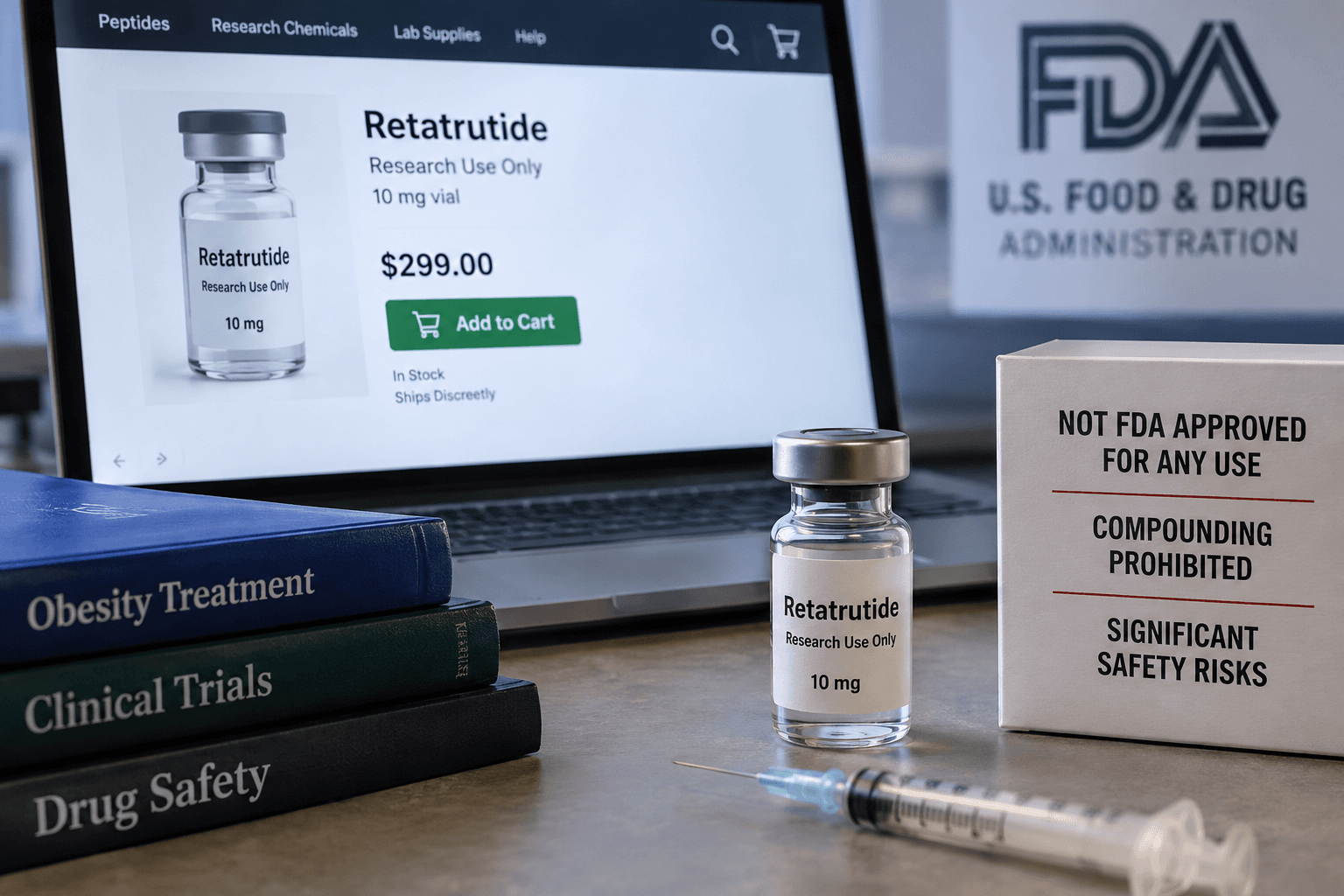
- Retatrutide is investigational and has no FDA-approved use for any condition.
- Phase 3 results in obesity and type 2 diabetes were presented in Milan and published in the New England Journal of Medicine and The Lancet.
- The FDA states that federal law does not permit retatrutide to be compounded or sold.
- Gray-market vials may contain the wrong amount of the drug, impurities, or no retatrutide at all.
- A March 2026 FDA warning letter to Gram Peptides identified retatrutide products as unapproved new drugs.
- Labels such as “research use only” do not make a product safe or lawful.
- Injectable products can cause serious harm by bypassing the body’s key defenses.
- Clinicians advise patients to ask about FDA-approved treatments, licensed pharmacies, and legitimate clinical trials.
Retatrutide can be ordered with a few clicks and a credit card, but the drug is not approved for any use. Federal regulators and clinicians who treat obesity and diabetes say the products sold under its name have not been shown to contain what their labels claim, and that promising clinical data do not change that.
Is retatrutide approved by the FDA?
Results from phase 3 clinical trials in obesity and type 2 diabetes were recently presented at the European Association for the Study of Diabetes meeting in Milan, with simultaneous publication in the New England Journal of Medicine and The Lancet. The findings are impressive. Still, retatrutide remains investigational, and the Food and Drug Administration (FDA) has not approved it for any condition.
Online, the drug is often called “Reta” or “GLP-3.” The nickname is inaccurate. The peptide acts on three hormone receptors, GLP-1, GIP, and glucagon, which makes it more accurately described as a “triple-G” agonist.
Why are retatrutide vials from online sellers risky?
The trial participants and the buyers of gray-market vials are not receiving the same thing. Those in clinical studies receive drugs manufactured to exacting specifications, at defined doses and escalation schedules, under close medical monitoring. A vial labeled “retatrutide” may or may not contain the molecule. It may contain more or less than the label states, or it may include impurities and contaminants that no one has tested for. Because no established dose exists for a product of unknown content, buyers often rely on guesswork from online forums to decide how much to inject. As one endocrinologist writing on the issue put it, promising data on the real drug reveal little about what is inside a gray-market vial.
The FDA’s position is direct. Federal law does not permit retatrutide to be compounded or sold. The agency notes that retatrutide is not an ingredient in any FDA-approved drug and has not been shown to be safe and effective for any condition. Labeling a product “compounded retatrutide” does not make it an approved or lawful treatment, and a “for research use only” label does not make it safe. The agency urges consumers not to buy these products, warning that their quality is unknown and that they may harm health.
The agency has also acted. In a March 2026 warning letter to Gram Peptides, the FDA identified products marketed as retatrutide as unapproved new drugs and said introducing them into interstate commerce violated federal law. The agency warned that injectable products can cause serious harm because they bypass the body’s key defenses against toxins and microorganisms. A professional-looking website or a glowing testimonial cannot confirm a product’s identity, strength, purity, or sterility.
Clinicians say the issue reaches the exam room. Patients often arrive with products they found on social media, at medical spas, or through friends and family, and their interest in affordable options is understandable. Their safety, however, depends on knowing what a product is and whether it has been tested to the standards applied to any medicine. Approved drugs pass through laboratory research and progressively larger clinical trials, are produced under strict quality controls in inspected facilities, and are monitored after they reach the market. Semaglutide and tirzepatide, sold as Ozempic, Wegovy, Mounjaro, and Zepbound, went through that process. Products sold online or at medical spas that use the same ingredient names do not automatically carry the same safeguards.
What should patients do instead of buying retatrutide online?
The practical guidance from clinicians is consistent. Patients should not buy or use retatrutide until it is FDA-approved and available from a legitimate manufacturer. They can ask their provider which approved treatments may fit their needs and how to obtain them through a licensed pharmacy. Patients interested in investigational therapies can ask about legitimate clinical trials. Technology has made information and products easier to reach, but it cannot replace medical guidance, and the next step toward better health should begin with a conversation with a clinician.
FAQ
- Is retatrutide FDA-approved?
- No. Retatrutide remains investigational, and the FDA has not approved it for any condition.
- Can gray-market retatrutide be trusted to contain the labeled amount?
- No. A vial labeled retatrutide may or may not contain the molecule, and it may contain more or less than the label states.
- What should patients do instead of buying retatrutide online?
- Patients should ask their provider which approved treatments may fit their needs and how to obtain them through a licensed pharmacy, or ask about legitimate clinical trials.
Read next
Desperate for Weight Loss, People Turn to Unapproved Retatrutide
Retatrutide, a promising weight-loss drug not yet approved by the FDA, is being sought after by people dissatisfied with current medications, with some turning to the gray market to purchase it, despite warnings from doctors about the risks to their health.

Two Deaths Linked to Counterfeit Retatrutide; Novo Nordisk to Drop Saxenda
Two recent deaths tied to counterfeit versions of retatrutide, an investigational weight-loss medication, have been reported to the Food and Drug Administration. The reports come as lawsuits against GLP-1 drugs continue, and as Novo Nordisk announced plans to discontinue its weight-loss injectable Saxenda in early 2027 because of declining sales. The World Health Organization also issued its first obesity guidelines for children and adolescents, and researchers released new findings on diabetes, dementia risk in women with PMOS, and a range of other conditions.
Eli Lilly's Obesity Drug Shows Promise, But Heart Benefits Remain Unclear
Eli Lilly's new obesity drug, retatrutide, has been shown to be highly effective in weight loss, with participants losing 22.6% of their weight after 80 weeks. However, the drug's impact on cardiovascular risk remains unclear due to a lack of statistically significant results in a recent Phase 3 study.
Eli Lilly Grants Access to Experimental Obesity Drug to 79-Year-Old Patient
Eli Lilly has given a 79-year-old patient access to its experimental obesity drug, retatrutide, through the FDA's compassionate use program. The move has raised eyebrows, with sources suggesting the patient may be well-connected. Retatrutide has shown promising results, with weight loss comparable to bariatric surgery.
Eli Lilly's Obesity Drug Granted Compassionate Use to One Person
In a rare move, Eli Lilly and the FDA have allowed one person to receive the company's obesity candidate, retatrutide, through the FDA's compassionate use program. This development comes as the pharmaceutical industry sees a resurgence in mergers and acquisitions, with Lilly also showing interest in a hair loss drug.