Gray-Market Peptides Are Everywhere. Here's What You Should Know.
Injectable peptides have moved from quiet laboratory research into wellness clinics, influencer videos, and biohacker forums. Many are sold through gray-market supply chains with little human safety data. Health Secretary Kennedy has pushed to restore access to peptides the FDA had restricted, and an FDA committee he reshaped has recommended letting six of them back into legal production through compounding pharmacies. Critics, including FDA scientists, warn that the products are often untested and inconsistently made. This guide walks through what peptides are, why the products are so popular, the risks researchers have flagged, and how the regulatory fight developed.
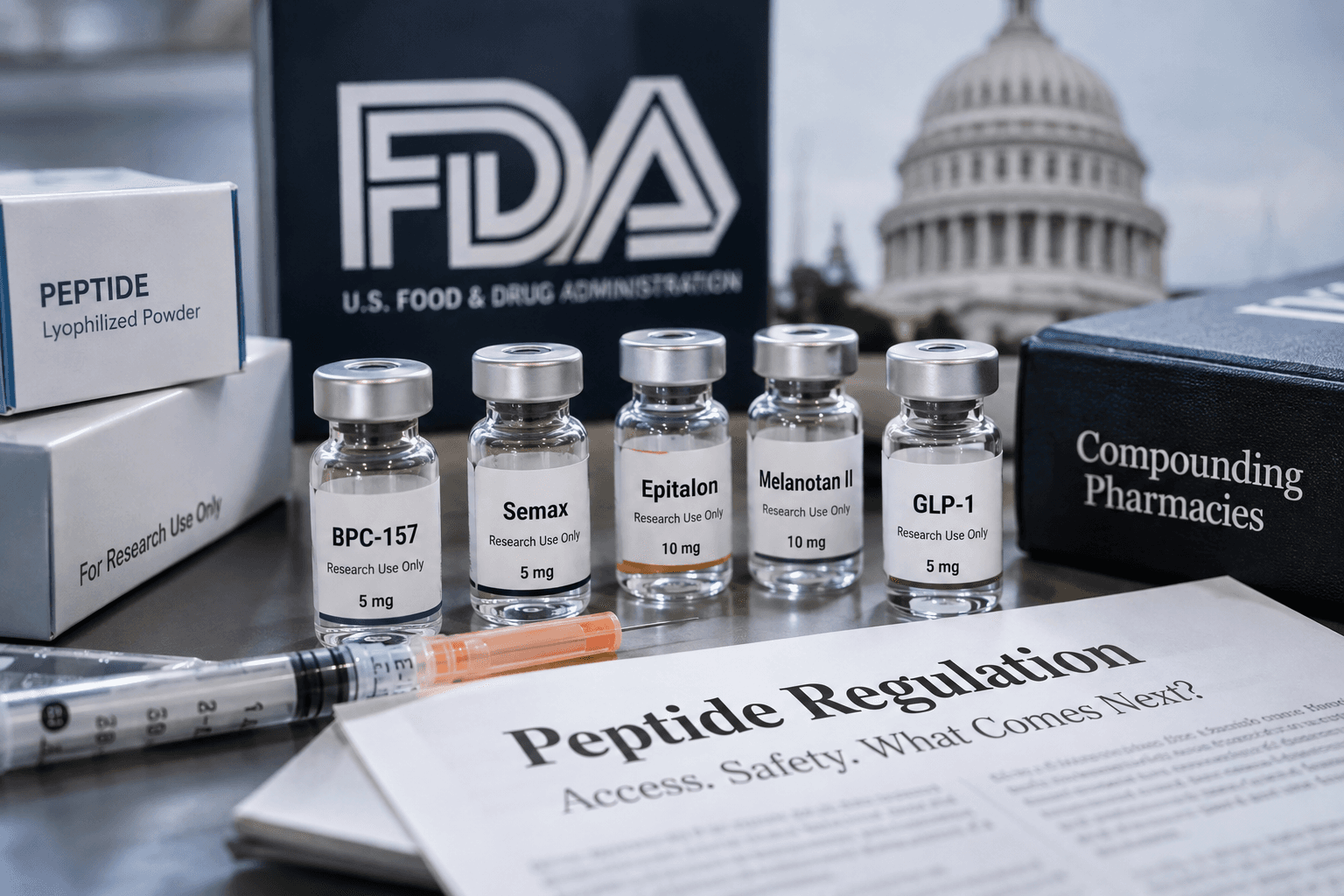
- Injectable peptides are showing up in wellness clinics, influencer videos, and biohacker communities.
- Many gray-market peptides are sold with little or no human safety data.
- Lab testing has found contamination, heavy metals, and undisclosed ingredients in some products.
- The FDA placed 19 popular peptides on a Category 2 list, limiting their use to research settings.
- A reshuffled FDA committee narrowly recommended letting six peptides return to compounding pharmacies.
- Critics say the committee overrode FDA staff scientists and that most research is limited to animals or early lab studies.
- Supporters frame access as a matter of medical freedom and natural healing.
- Denmark strictly prohibits the sale and private importation of gray-market peptides.
Injectable peptides are suddenly all over the place. You can find them in wellness clinics, in influencer videos, and in biohacker forums. They have also become part of Health Secretary Kennedy’s broader wellness agenda. If you have been wondering what these products are, why they are so popular, and why scientists are worried, this guide breaks it down step by step.
What peptides are and where they came from
What are peptides and where did they come from?
Peptides are short chains of amino acids, the building blocks of proteins. They help signal cells to do specific things, such as reduce inflammation or produce collagen. Peptide science is not new or fringe. The most famous therapeutic peptide is insulin, which Frederick Banting and Charles Best discovered in 1921. Insulin turned type 1 diabetes from a fatal diagnosis into a chronic, manageable condition.
Scientists isolated glucagon-like peptide-1, or GLP-1, in 1986. Decades of research later led to major breakthroughs in obesity treatment, including drugs such as Ozempic and metabolic medicine. Those successes helped fuel public interest in longevity, which refers to extending the years people spend in good health, not just the number of years they live.
That is where things get messy. What was once a steady scientific advance has turned into a regulatory fight over the safety, legality, and distribution of unapproved wellness injectables.
Why gray-market products are so popular and so risky
Today’s peptide market has two sides. One is a multibillion-dollar pharmaceutical sector built around GLP-1 drugs such as Semaglutide. The other is a fast-growing gray market that sells unverified research chemicals. Many of the gray-market products are promoted for specific goals:
- Healing and muscle recovery: BPC-157 is advertised for tendon and joint repair, and thymosin beta-4 is promoted for tissue health and flexibility.
- Body composition: Ipamorelin and CJC-1295 are marketed for growth hormone release and fat loss, and AOD-9604 is promoted for fat breakdown.
- Cognition and mood: Semax is claimed to support focus and memory.
- Longevity: Epitalon is touted for cellular resilience and stress response.
The catch is that most of these products lack robust human data. Many of the concerns are about unregulated purity and unknown side effects. For example, Semax has been linked to headaches, overstimulation, and insomnia, and its long-term effects are uncertain.
Melanotan II, sometimes called the “Barbie peptide,” is a good case study. It promises a sunless tan by signaling skin cells to produce more pigment, and it first gained popularity in bodybuilding circles as a way to build a “base tan.” In one study of 29 self-reported users, everyone reported increased tanning, though some described the color as a dull gray. Common side effects included nausea, flushing, and fatigue. More serious risks included muscle breakdown and priapism. Dermatologists have also raised concerns that it could increase melanoma risk.
So, who knows? That is exactly why medical research matters.
Why are gray-market peptides risky?
Beyond the unknowns of any single compound, gray-market peptides carry broader quality problems. Many are sold outside normal safety controls, which means they are often untested and inconsistently made. Some have been found to contain bacterial contamination, dangerous endotoxins, heavy metals, or ingredients that were never disclosed. Analyses have also found that many fail basic chemical and quality tests. Peptides can break down quickly without a temperature-controlled supply chain, becoming inactive, unstable, or unsafe. Impurities or degraded peptides can also provoke severe immune reactions, including allergic shock.
How the FDA debate reached this point
During the Biden administration, the FDA placed 19 popular peptides on a “Category 2” list. That classification limited their use to research settings and effectively barred compounding pharmacies from mixing and selling them.
What is the FDA debate over peptides?
In mid-2026, Secretary Kennedy criticized those restrictions as regulatory overreach and pushed to restore access. He reshuffled the FDA committee roster, adding six members with ties to, and financial interests in, the peptide industry. The committee then overrode FDA staff scientists and narrowly recommended that six peptides be allowed back into legal production through compounding pharmacies.
Kennedy has been open about his own views. On Joe Rogan’s podcast this past February, he said, “I’m a big fan of peptides… I’ve used them myself and used [them] with really good effect with a couple of injuries.” In a separate 2025 podcast with Gary Brecka, a biohacker who sells peptides, he said the FDA should “just do the science” on products like peptides and stem cell treatments, “but not tell people, and not tell physicians, what they can and cannot prescribe.”
For comparison, in Denmark, the sale, purchase, and private importation of gray-market peptides are strictly illegal.
Critics, including FDA scientists and medical researchers, argue that these products lack adequate human trials, and most available research has been limited to animals or early laboratory studies. Supporters, including longevity advocates, wellness clinics, and influencers, say peptides are natural signaling molecules that can support healing. They frame the issue as one of “medical freedom,” arguing that patients and physicians should be able to choose alternative therapies without FDA interference.
Dr. Pieter Cohen, an associate professor at Harvard Medical School, put the stakes plainly: “It’s going to reposition the FDA in a much weaker position if they cave to this kind of political pressure… because there’s no reason these peptides should be approved.”
If you are considering any peptide product, the practical takeaway is simple. Ask where it came from, whether it has human safety data, and whether a licensed clinician is involved. Until the research catches up with the hype, those answers matter more than any online testimonial.
FAQ
- Are gray-market peptides legal in Denmark?
- No. In Denmark, the sale, purchase, and private importation of gray-market peptides are strictly illegal.
- What did the FDA do to 19 popular peptides?
- The FDA placed them on a Category 2 list, which limited their use to research settings and effectively barred compounding pharmacies from mixing and selling them.
- Do most gray-market peptides have robust human data?
- No. The story states that most of these products lack robust human data, and many concerns involve unregulated purity and unknown side effects.
Read next
HHS Moves Ahead With Plan to Let Pharmacies Compound Popular Peptides
The Trump administration has sent an "interim access policy" for peptides to the White House for review, a step that would let specialty pharmacies compound certain widely used peptides. The peptides, including BPC-157, have gained popularity among followers of Health Secretary Robert F. Kennedy Jr. and wellness influencers, but they have not gone through the FDA's standard approval process, and most of the available data comes from animal studies. An FDA advisory panel recommended lifting restrictions on six of seven peptides in July, a recommendation that ran counter to the conclusions of the agency's own scientists. The policy's exact terms have not been published, and formal rulemaking could take years.

Users Report Harm From Unapproved Peptides as Federal Panel Moves to Loosen Limits
Users of unapproved peptides such as BPC-157 are reporting fatigue, migraines, and other side effects, even as an FDA advisory panel with industry-linked members has voted to ease restrictions on six experimental peptides. The vote went against FDA scientists who found too little evidence that the drugs work. The FDA has not issued a final decision, and clinical data on the drugs remain thin. Health Secretary Robert F. Kennedy Jr. has pushed to lower barriers to peptide use, and many companies could soon drop required warnings that their products are for research only.

Peptide ETFs Multiply as Wall Street Chases the Wellness Trend
REX Shares recently launched the REX Peptide ETF (PEPT), a fund holding companies that develop and manufacture peptide products, including GLP-1 drugs. Eli Lilly and Novo Nordisk are among its holdings. AdvisorShares has filed for a competing fund, the Peptide and Human Enhancement ETF. Other firms are also building wellness-themed funds, but investor money has not yet kept pace with the buzz. Some funds have seen outflows, and analysts say the sector's appeal may depend on timing and the broader market.
Desperate for Weight Loss, People Turn to Unapproved Retatrutide
Retatrutide, a promising weight-loss drug not yet approved by the FDA, is being sought after by people dissatisfied with current medications, with some turning to the gray market to purchase it, despite warnings from doctors about the risks to their health.

Two Deaths Linked to Counterfeit Retatrutide; Novo Nordisk to Drop Saxenda
Two recent deaths tied to counterfeit versions of retatrutide, an investigational weight-loss medication, have been reported to the Food and Drug Administration. The reports come as lawsuits against GLP-1 drugs continue, and as Novo Nordisk announced plans to discontinue its weight-loss injectable Saxenda in early 2027 because of declining sales. The World Health Organization also issued its first obesity guidelines for children and adolescents, and researchers released new findings on diabetes, dementia risk in women with PMOS, and a range of other conditions.