Survodutide Shows No Added Cardiovascular Risk in Trial of Patients With Obesity
A large randomized trial found that survodutide, an investigational drug that targets both the glucagon and GLP-1 receptors, was safe for adults with obesity who had established cardiovascular disease, chronic kidney disease, or an increased risk of cardiovascular disease. Among more than 5,500 patients, the rate of major cardiovascular events was 3.7% on survodutide and 4.1% on placebo, meeting the noninferiority standard. The results were presented at the American Heart Association annual meeting and published simultaneously in The Lancet. Investigators said the study shows cardiovascular harm can be ruled out, but it does not show cardiovascular benefit.
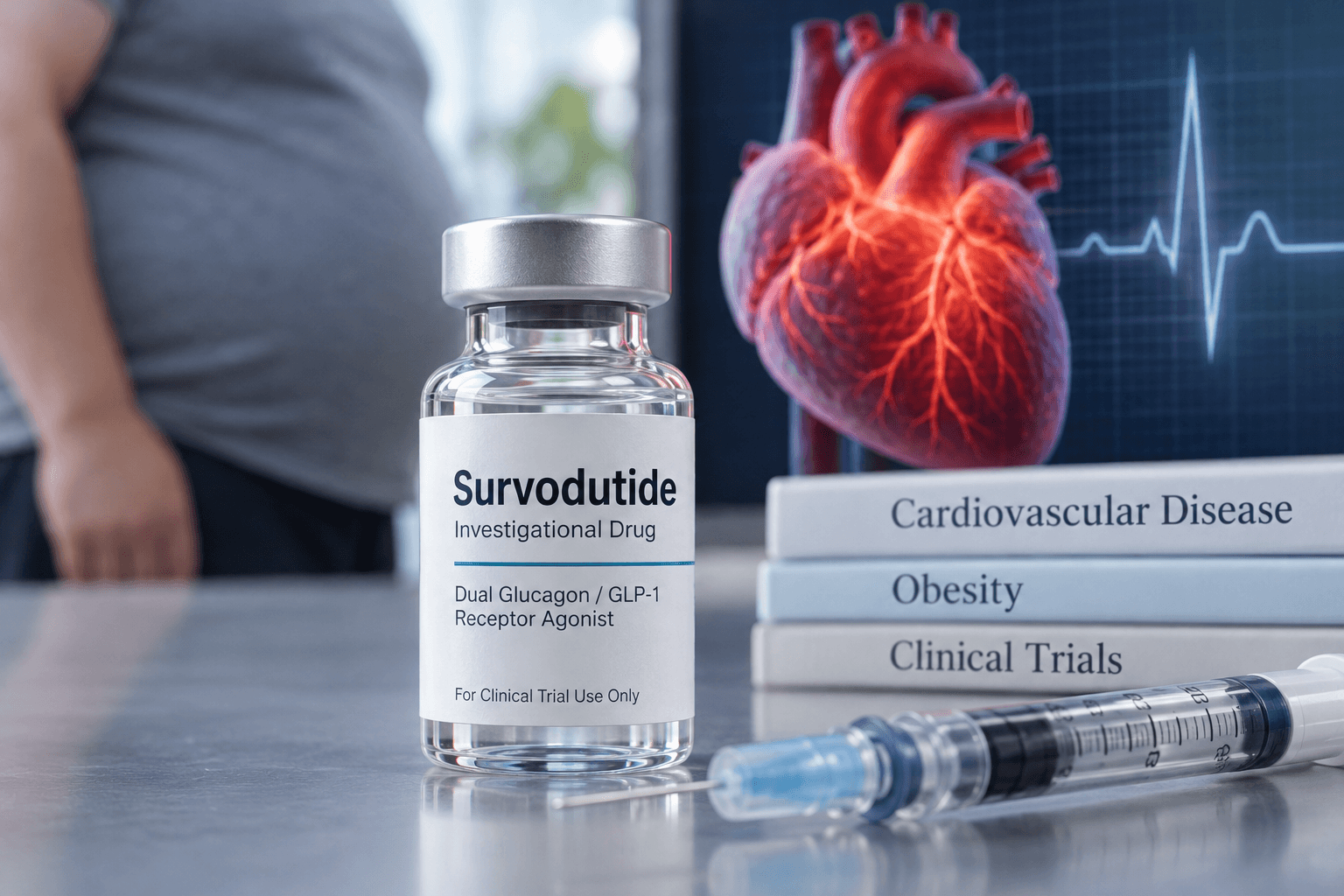
- Survodutide, a glucagon and GLP-1 dual agonist, met noninferiority for cardiovascular safety versus placebo.
- The SYNCHRONIZE-CVOT trial enrolled 5,530 adults with obesity and established cardiovascular disease, chronic kidney disease, or elevated cardiovascular risk.
- The primary composite endpoint occurred in 3.7% of survodutide patients and 4.1% of placebo patients (P <0.0001).
- Gastrointestinal events drove discontinuations: 19.3% and 20.8% on the two survodutide doses versus 1.9% on placebo.
- Participants on survodutide also saw improvements in blood pressure, waist circumference, HbA1c, body weight, and lipids.
- Investigators said the trial rules out cardiovascular harm but cannot show cardiovascular benefit.
- Results were presented at the AHA annual meeting and published in The Lancet.
Survodutide, an investigational drug that acts on both the glucagon and GLP-1 receptors, did not increase cardiovascular risk in adults with obesity who had established cardiovascular disease, chronic kidney disease, or an increased risk of cardiovascular disease, according to a randomized trial. The findings were presented at the American Heart Association (AHA) annual meeting in Chicago and published simultaneously in The Lancet.
The study, called SYNCHRONIZE-CVOT, was a global, phase III, randomized, double-blind, placebo-controlled, event-driven cardiovascular safety trial conducted at 524 sites in 34 countries. Adults were eligible if they had a body mass index of 27 kg/m2 or greater and either established cardiovascular disease or at least two obesity complications or cardiovascular risk factors. Participants with chronic kidney disease needed a BMI of 30 kg/m2 or greater. A total of 5,530 patients were randomly assigned to a once-weekly subcutaneous dose of survodutide, up-titrated to 3.6 mg or 6.0 mg, or to placebo. Of these, 5,507 were treated, with patients divided equally among the three arms.
Does survodutide increase cardiovascular risk?
The primary endpoint was a composite of death from cardiovascular causes, nonfatal stroke, nonfatal myocardial infarction, ischemia-related coronary revascularization, or heart failure event. It occurred in 3.7% of patients taking survodutide and 4.1% of those on placebo, a result that met the threshold for noninferiority (P <0.0001). A secondary three-point endpoint, covering cardiovascular death, nonfatal stroke, and nonfatal myocardial infarction, occurred in 2.4% of 3,671 participants in the pooled survodutide group and 2.8% of 1,836 in the placebo group, again meeting noninferiority (P <0.0001).
Biykem Bozkurt, MD, PhD, of Baylor College of Medicine in Houston, presented the results and said the trial “met its primary endpoint, establishing cardiovascular safety by demonstrating noninferiority to placebo for MACE [major adverse cardiovascular events].” She and her colleagues described the data as “reassuring” for clinicians considering the dual agonist. The authors wrote that establishing cardiovascular safety through noninferiority trials is essential for this new class of drugs. Bozkurt added that regulatory agencies in the U.S. and Europe have come to expect this kind of evidence.
What side effects were reported with survodutide?
Gastrointestinal side effects were more common in the treated groups, particularly during the dose-escalation phase. Adverse events occurred in 93.0% of patients on the 3.6-mg dose and 93.1% on the 6.0-mg dose, compared with 85.6% on placebo. Gastrointestinal events, including nausea and vomiting, led to discontinuation in 19.3% of the 3.6-mg group, 20.8% of the 6.0-mg group, and 1.9% of the placebo group. Serious and fatal adverse events were similar across treatment groups, and the authors noted that fatal events were primarily due to cardiac disorders. Bozkurt said the safety profile was consistent with previously reported phase III trials, with no unexpected safety findings.
Treatment with survodutide was also associated with improvements in systolic blood pressure, waist circumference, HbA1c, body weight, lipid levels, and high-sensitivity C-reactive protein, Bozkurt said. Median time in the study was 22 months. At study close-out, 56.0% of the 3.6-mg group, 56.6% of the 6.0-mg group, and 59.0% of the placebo group were still on treatment.
AHA discussant Stephen Nicholls, MBBS, PhD, of Monash University in Melbourne, Australia, noted a key limitation of the design. While the trial shows that cardiovascular harm can be excluded, he said, “we cannot make any inference about cardiovascular benefit.”
Nicholls also questioned how such trials are designed. “From a regulatory perspective, it would seem it’s a relatively low bar to simply show that there’s no cardiovascular harm,” he said. “We need to think more and more about how do we design clinical trials with what’s important for our patients and the clinicians that they are working with.” He added that the longer-term goal is to match the right patient with the right treatment at the right time in the disease process, and to support shared decision-making for more personalized prevention of cardiovascular disease and obesity complications.
Does survodutide reduce cardiovascular events?
For now, the trial answers a narrow but important question: whether survodutide adds cardiovascular risk in a high-risk population with obesity. It does not yet establish whether the drug reduces cardiovascular events, and that question will require further study.
FAQ
- Did survodutide increase cardiovascular risk in the trial?
- No. The primary endpoint occurred in 3.7% of survodutide patients and 4.1% of placebo patients, meeting the threshold for noninferiority to placebo.
- Does survodutide reduce cardiovascular events?
- Not yet established. The trial shows cardiovascular harm can be excluded, but it does not yet establish whether the drug reduces cardiovascular events, which will require further study.
- What side effects were reported with survodutide?
- Gastrointestinal side effects were more common in treated groups, particularly during dose escalation. Discontinuation due to gastrointestinal events occurred in 19.3% of the 3.6-mg group, 20.8% of the 6.0-mg group, and 1.9% of the placebo group.
Read next
Retatrutide Eases Knee Osteoarthritis Pain in Patients With Obesity, Trial Finds
An investigational obesity drug, retatrutide, significantly reduced pain and improved physical function in adults with obesity and knee osteoarthritis, according to the phase 3 TRIUMPH-4 trial. Results were presented at the American College of Rheumatology annual meeting and published simultaneously in the New England Journal of Medicine. The drug targets three hormone receptors and produced substantial weight loss, but a higher rate of side effects than placebo, and the researchers called for further studies on how it works and whether it can modify the disease itself.
Eli Lilly's Obesity Drug Shows Promise, But Heart Benefits Remain Unclear
Eli Lilly's new obesity drug, retatrutide, has been shown to be highly effective in weight loss, with participants losing 22.6% of their weight after 80 weeks. However, the drug's impact on cardiovascular risk remains unclear due to a lack of statistically significant results in a recent Phase 3 study.
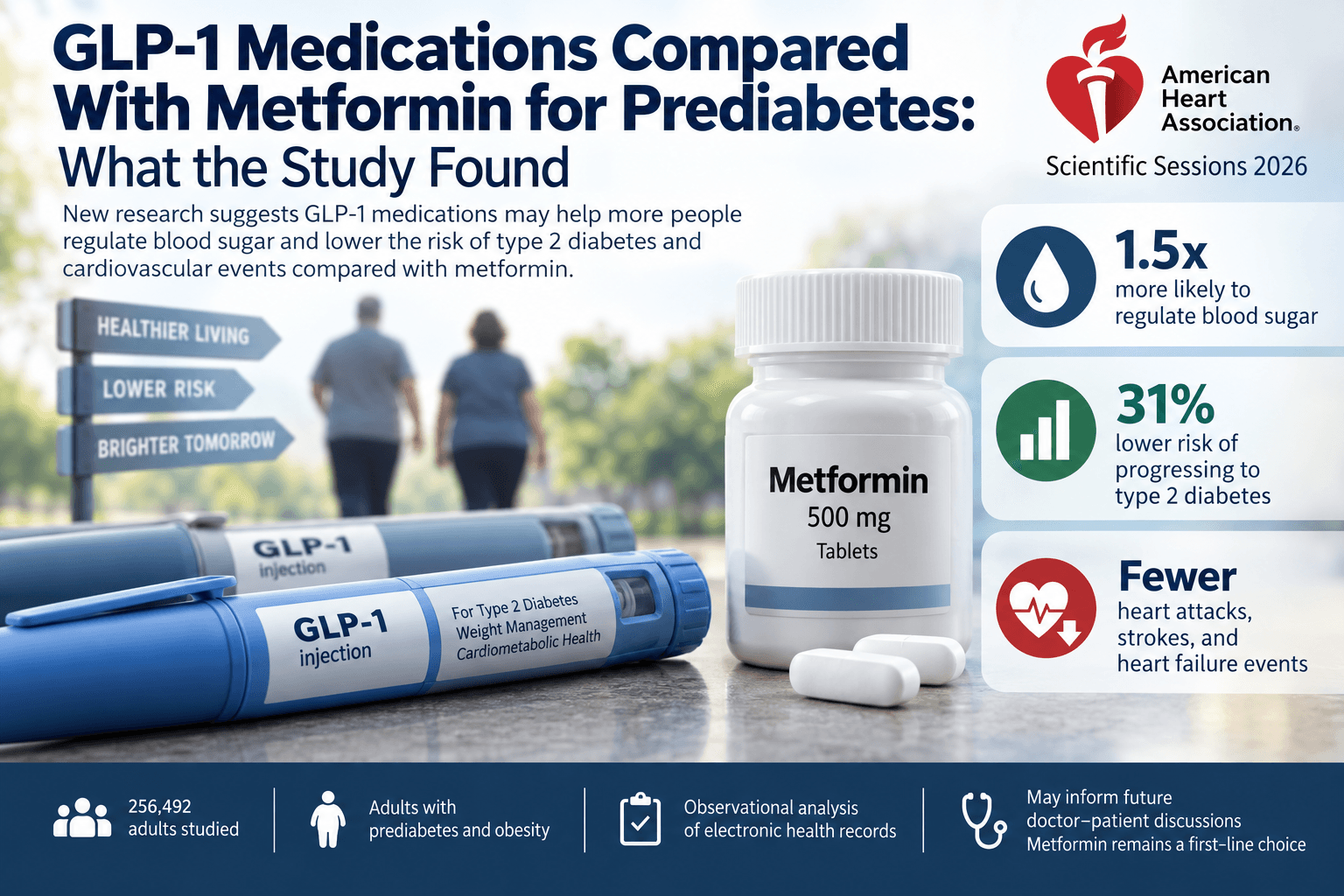
GLP-1 Medications Compared With Metformin for Prediabetes: What the Study Found
A study presented at the American Heart Association Scientific Sessions 2026 found that adults with prediabetes and obesity who took a GLP-1 medication were about 1.5 times more likely than those on metformin to regulate their blood sugar. They also had a 31% lower risk of progressing to type 2 diabetes. The observational analysis reviewed electronic health records from 256,492 adults and reported fewer heart attacks, strokes, and heart failure events among GLP-1 users. Researchers say the results could shape conversations between doctors and patients about treatment options, though metformin remains a first-line choice.
GLP-1 Drugs Linked to Better Survival After Liver Transplant
Liver transplant patients who took GLP-1 receptor agonists after surgery were 45% less likely to die than those who did not, according to a retrospective three-center study of 2,402 patients presented at the American Association for the Study of Liver Diseases Liver Meeting in Denver. A replication cohort of 1,443 U.S. claims-database patients showed similar results. Researchers said the drugs appear to lower deaths from causes other than liver failure, including cardiovascular events and cancer, though the reasons remain unclear and the study has limits. The findings add to a growing case for metabolic care in transplant patients as fatty liver disease becomes a leading cause of transplant.

Two Deaths Linked to Counterfeit Retatrutide; Novo Nordisk to Drop Saxenda
Two recent deaths tied to counterfeit versions of retatrutide, an investigational weight-loss medication, have been reported to the Food and Drug Administration. The reports come as lawsuits against GLP-1 drugs continue, and as Novo Nordisk announced plans to discontinue its weight-loss injectable Saxenda in early 2027 because of declining sales. The World Health Organization also issued its first obesity guidelines for children and adolescents, and researchers released new findings on diabetes, dementia risk in women with PMOS, and a range of other conditions.