CagriSema Shows Weight Loss Across Menopause Stages, Including Women on Hormone Therapy
New data from a post-hoc analysis of Novo Nordisk's REDEFINE 1 trial suggest that the investigational combination CagriSema produced clinically meaningful weight loss in women at every menopause stage studied, including those using hormone therapy. Presented at The Menopause Society's 2026 Annual Meeting, the analysis of 1,902 women found mean reductions of 23.1% to 26.7% over 68 weeks, along with improvements in blood pressure, fasting glucose, and triglycerides. The findings are investigational and come from a post-hoc analysis, so they do not establish how the drug will perform in practice. An FDA decision is anticipated in late 2026, and pharmacists are expected to play a key role in counseling patients.

- A post-hoc analysis of the REDEFINE 1 trial, presented at The Menopause Society's 2026 Annual Meeting, looked at CagriSema in women across menopause stages.
- The analysis included 1,902 women aged 18 to 81 with overweight or obesity, followed for 68 weeks.
- Mean weight reductions ranged from 23.1% to 26.7% across pre-menopause, peri-menopause, post-menopause, and HT use groups.
- Blood pressure, fasting glucose, and triglyceride improvements were significant in all subgroups.
- The authors noted that no formal subgroup interaction testing was performed.
- Gastrointestinal side effects were the most common, mostly mild to moderate and transient.
- CagriSema did not achieve noninferiority to the 15 mg dose of tirzepatide in the REDEFINE 4 trial.
- An FDA decision is anticipated in late 2026.
CagriSema, an investigational combination of semaglutide and cagrilintide, produced weight loss in women across all menopause stages studied, including those using hormone therapy. In a post-hoc analysis of the REDEFINE 1 trial presented at The Menopause Society's 2026 Annual Meeting, mean reductions ranged from 23.1% to 26.7% over 68 weeks.
Many women want to know whether weight-loss medications work the same way at every stage of life. A new analysis presented at The Menopause Society's 2026 Annual Meeting offers some early answers for one investigational option. In a post-hoc analysis of the REDEFINE 1 trial, the combination of cagrilintide and semaglutide, known as CagriSema, led to weight loss in women across all menopause stages studied, including those using hormone therapy (HT).
Does CagriSema cause weight loss in women at every menopause stage?
The study looked at 1,902 women aged 18 to 81 who had overweight or obesity. Participants were divided into four cohorts: pre-menopause, peri-menopause, post-menopause, and HT use. Over 68 weeks, mean weight reductions were 26.7% in pre-menopausal women, 24.8% in peri-menopausal women, 23.1% in post-menopausal women, and 25.6% among women using HT. Between 91% and 95.1% of participants reached at least a 10% weight loss, while 63.2% to 78.3% achieved at least a 20% reduction. Waist circumference fell between 19.2 and 21.7 centimeters.
The researchers also tracked cardiometabolic markers. Improvements in blood pressure, fasting glucose, and triglycerides were significant regardless of reproductive stage or HT use. Cholesterol changes were less consistent. The authors noted that weight reduction was numerically greater in pre-menopausal women, and a larger share of that group reached at least a 20% reduction. However, they cautioned that no formal treatment-by-subgroup interactions were tested, so those differences should be read with care.
How CagriSema works and how it compares with other options
CagriSema pairs two peptide compounds that act on appetite through different pathways. Timothy Garvey, MD, a professor of medicine at the University of Alabama at Birmingham, described it this way: the GLP-1 receptor agonist semaglutide and the long-acting amylin cagrilintide work in an additive way. In his words, adding cagrilintide to semaglutide yields additional weight loss, and he noted that cagrilintide is well tolerated compared with GLP-1 medications.
Other recent research adds context. Functional MRI over 52 weeks showed that CagriSema changed how the brain responded to high-calorie food cues in areas tied to reward and craving. Magnetic resonance imaging substudies in people with type 2 diabetes also found reductions in fat around the liver and pancreas, as well as abdominal visceral fat. A systematic review and meta-analysis of eight randomized trials, involving 6,898 participants, found greater weight reductions with CagriSema than with semaglutide alone, cagrilintide alone, or placebo.
How does CagriSema compare with tirzepatide?
Head-to-head data are more mixed. In the phase 3 REDEFINE 4 trial, which included 809 participants, CagriSema produced a 23% mean weight loss over 84 weeks. It did not achieve noninferiority against the highest 15 mg dose of tirzepatide, which led to a 25.5% reduction.
What pharmacists should watch for
What are the side effects of CagriSema?
Across the clinical studies, the most common adverse events were gastrointestinal, including nausea and diarrhea. These were mostly mild to moderate and tended to fade over time. Pooled meta-analysis data found that gastrointestinal events occurred more often with the dual agonist, but serious adverse events did not differ significantly between CagriSema and the comparison groups.
At the American Pharmacists Association 2026 Annual Meeting, Emily Eddy, PharmD, argued that multi-agonist therapies are changing practice by addressing underlying cardio-kidney-metabolic health rather than isolated glycemic numbers. Pharmacists are advised to monitor patients who lose weight rapidly for potential lean muscle loss of 15% to 25%, and to screen for micronutrient deficiencies in vitamins D and B12.
CagriSema remains investigational, and an FDA decision is anticipated in late 2026. Until then, the authors of the meeting poster framed the findings as a starting point for conversation rather than a final answer. For clinicians and patients alike, the message is that these results are promising but still early, and any decision about treatment is best made with a qualified health care provider who can review individual history and goals.
FAQ
- Does CagriSema lead to weight loss in women using hormone therapy?
- Yes. In the post-hoc REDEFINE 1 analysis, women using hormone therapy had a mean weight reduction of 25.6% over 68 weeks.
- Is CagriSema approved by the FDA?
- No. CagriSema remains investigational, and an FDA decision is anticipated in late 2026.
- Are serious adverse events more common with CagriSema?
- Pooled meta-analysis data found no significant difference in serious adverse events between CagriSema and the comparison groups, although gastrointestinal events occurred more often with the dual agonist.
Read next

Low T in Army Men, GLP-1 Blood Pressure Data and Retatrutide Side Effects Make the News
A new round of health research points to a wide range of hormone and metabolic findings. Roughly a quarter of active-duty U.S. Army men had a morning testosterone level under 300 ng/dL, a common cutoff for low testosterone. A CDC report found nearly half of American women ages 40 to 60 reported menopausal symptoms in 2025, and 15.6% of them took prescription medication for those symptoms. Separate studies linked GLP-1 drugs to blood pressure drops and early anti-aging signals. Novo Nordisk reported weight-loss results in women, and Walmart said it will cover over 250 prescription drugs, including some GLP-1 drugs for diabetes, for employees in 2027. An analysis of Reddit posts also cataloged side effects reported by users of the unapproved weight-loss drug retatrutide.

Two Deaths Linked to Counterfeit Retatrutide; Novo Nordisk to Drop Saxenda
Two recent deaths tied to counterfeit versions of retatrutide, an investigational weight-loss medication, have been reported to the Food and Drug Administration. The reports come as lawsuits against GLP-1 drugs continue, and as Novo Nordisk announced plans to discontinue its weight-loss injectable Saxenda in early 2027 because of declining sales. The World Health Organization also issued its first obesity guidelines for children and adolescents, and researchers released new findings on diabetes, dementia risk in women with PMOS, and a range of other conditions.
Lilly Data Puts Orforglipron and Tirzepatide Ahead of Semaglutide
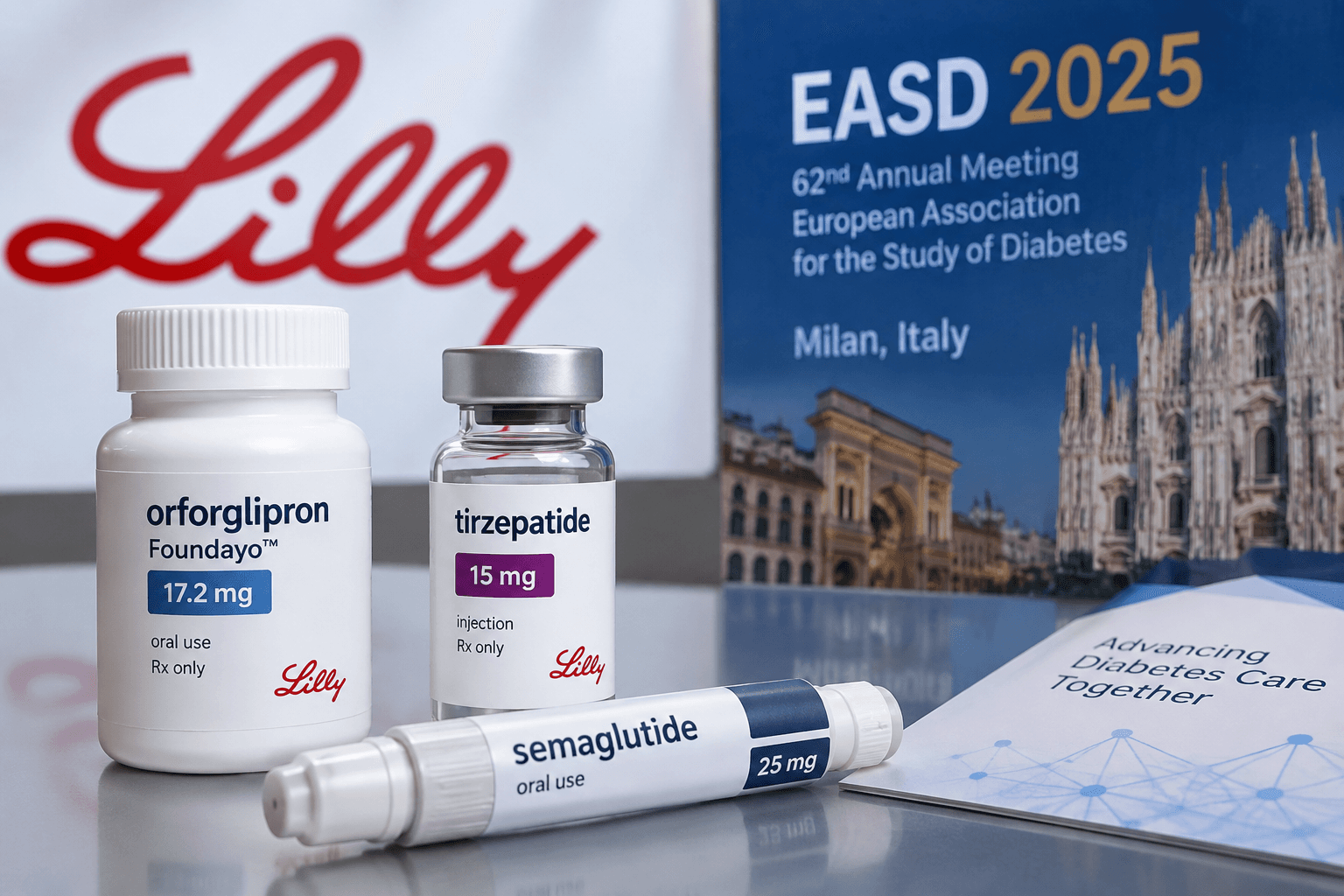
Eli Lilly announced two indirect treatment comparisons showing its drugs outperform semaglutide on weight loss and blood sugar control. Neither result comes from a head-to-head trial. Orforglipron (Foundayo) 17.2 mg produced 1.5% greater weight loss and 0.3% greater A1C reduction than oral semaglutide 25 mg at 52 weeks in adults with type 2 diabetes. Tirzepatide 15 mg beat semaglutide 7.2 mg by 4.5% on body weight at 72 weeks, but that gap was not statistically significant under the efficacy estimand. The analyses were presented at the 62nd Annual Meeting of the European Association for the Study of Diabetes in Milan, Italy. The release did not include safety data for the indirect comparisons.

Semaglutide and Fewer Asthma Attacks: What the New Data Shows
A large real-world study presented at the ERS Congress in Barcelona found that people with asthma who started semaglutide, sold as Ozempic and Wegovy, had nearly 40% fewer asthma attacks than similar patients on a different diabetes medication. Researchers also reported lower COPD flare-ups and a possible link to fewer psychiatric hospitalizations. The findings are observational, and the researchers say they should not change how GLP-1 drugs are prescribed until clinical trials confirm them.
Semaglutide Tied to Lower Bone Fracture Risk in Diabetes Patients
A new study finds that people taking semaglutide for diabetes have a lower rate of bone fractures compared to those taking other anti-obesity medications. Researchers analyzed data from over 159,000 patients and found that semaglutide treatment was associated with a greater reduction in body mass index and fewer fractures.