FDA Adds Vision Loss Warning to GLP-1 Drugs, Leaving Doctors and Patients With Hard Choices
The FDA will require new warnings across the entire GLP-1 drug class about a possible increased risk of NAION, a rare condition that damages the optic nerve and can cause permanent vision loss. The class includes Ozempic, Wegovy, Zepbound and Mounjaro. Because the drugs are widely used, the warning forces a difficult question: when a patient develops NAION, should treatment stop? Regulators in Europe and the U.S. have answered differently. An ophthalmologist who has asked patients about GLP-1 use for two years says the FDA should now study what happens after a diagnosis, and that patients cannot wait years for answers.
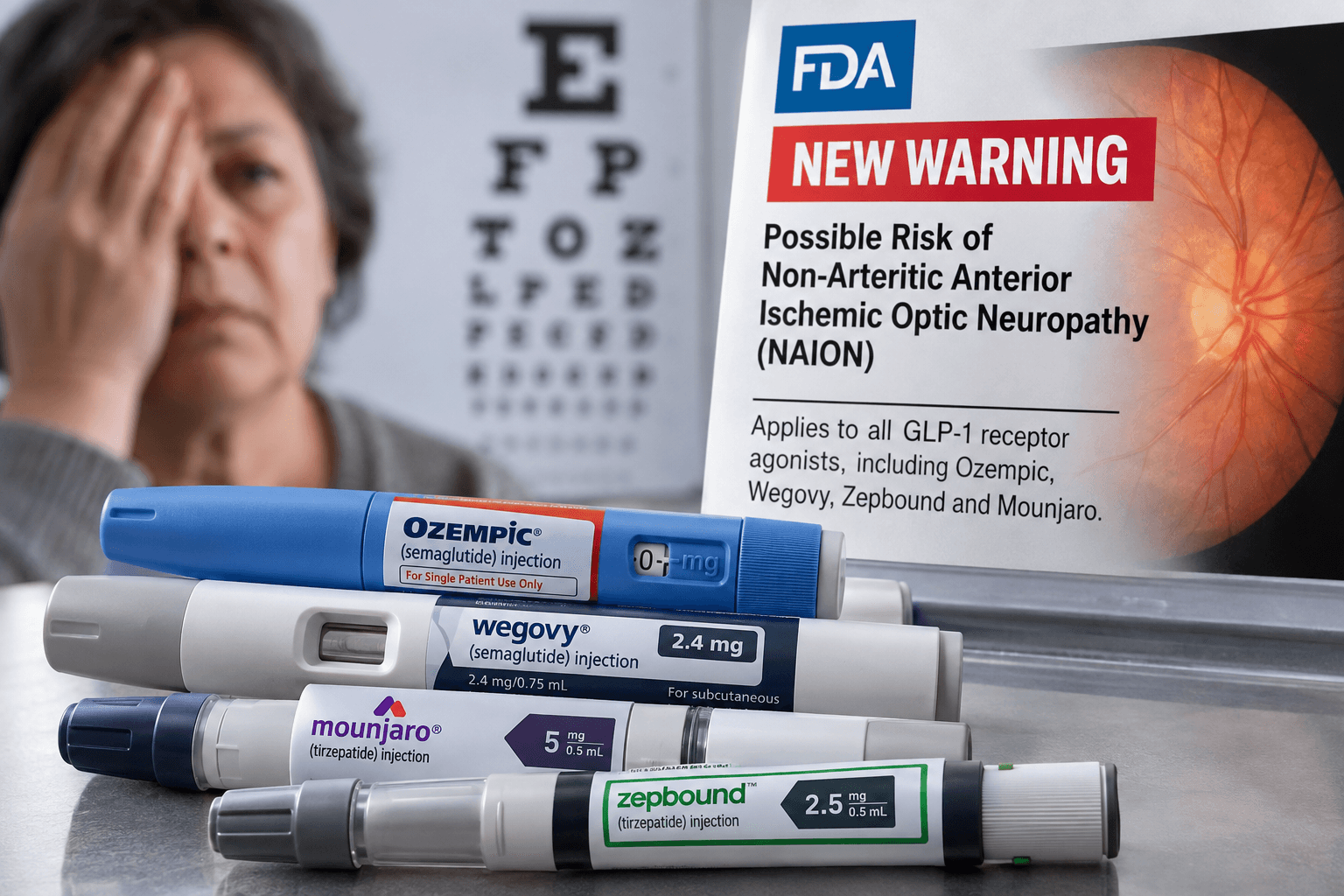
- The FDA will require new warnings across the entire GLP-1 drug class about a possible increased risk of NAION.
- The class includes semaglutide (Ozempic, Wegovy) and tirzepatide (Zepbound, Mounjaro), among others.
- NAION damages the optic nerve and can cause sudden, painless, and potentially permanent vision loss.
- There is no proven treatment to reverse NAION.
- In a March 2026 KFF poll, about one in eight U.S. adults currently took a GLP-1 drug.
- The FDA identified 15 probable NAION cases across 126 clinical trials.
- European guidance says to stop semaglutide if NAION is confirmed; the FDA advises considering discontinuation unless benefits clearly outweigh the risk.
- Regulators have not settled whether continuing treatment after a NAION diagnosis raises the risk to the second eye.
The FDA is requiring new warnings across the entire GLP-1 drug class over a possible increased risk of non-arteritic anterior ischemic optic neuropathy, or NAION. The announcement came on November 9. The class includes semaglutide, sold as Ozempic and Wegovy, and tirzepatide, sold as Zepbound and Mounjaro, among others.
The condition is rare. The drugs are not. In a March 2026 KFF poll, about one in eight U.S. adults said they currently take a GLP-1 drug. One in five said they had ever taken one.
What is NAION and why is the FDA warning about it?
NAION occurs when inadequate blood flow damages the nerve that carries visual information from the eye to the brain. It can cause sudden, painless vision loss, often noticed on waking. The loss can be permanent. There is no proven treatment to reverse it.
Is the link between GLP-1 drugs and vision loss proven?
The science behind the warning is still incomplete. Across 126 clinical trials, the FDA identified 15 probable NAION cases. The rate was roughly six cases per 100,000 patients followed for a year among those receiving GLP-1 drugs. Among those receiving a placebo or another diabetes medication, the rate was four. Larger observational studies have also raised concern. Their estimates vary, and they cannot fully separate the effects of treatment from the conditions that led patients to receive it.
Those numbers answer one question. They do not answer the next one. What should a patient do after a NAION diagnosis?
Should patients stop GLP-1 drugs after a NAION diagnosis?
Regulators have split on that point. European guidance says to stop semaglutide if NAION is confirmed. The FDA advises clinicians to consider discontinuation unless the benefits clearly outweigh the risk. The U.S. warning covers the broader drug class, while the European guidance addresses semaglutide specifically.
Stopping is not simple. Some patients take these drugs to manage diabetes that has resisted other treatment. Certain drugs in the class also reduce the risk of heart attacks or worsening kidney disease in eligible patients. Stopping requires a plan for the condition being treated.
Patients who develop NAION in one eye already face a higher risk of developing it in the other. How GLP-1 drugs might contribute remains unclear. One hypothesis holds that rapid reductions in blood sugar could cause swelling where the optic nerve enters the eye, which could compromise blood flow in susceptible patients. That idea does not show whether staying on the medication adds risk to the second eye, or whether stopping lowers it.
One analysis presented at the American Academy of Ophthalmology annual meeting this fall offered a partial clue. Among patients who developed NAION in both eyes, the second eye was affected sooner in GLP-1 users. The analysis did not establish whether stopping the drug would have prevented that outcome. Doctors also lack reliable comparative evidence that switching to another GLP-1 drug is safer.
An ophthalmologist who has routinely asked patients with suspected NAION about GLP-1 use for the past two years says the warning is overdue and welcome. The FDA should now pair it with a study of what happens when patients stop, continue or change treatment after a diagnosis, the doctor argues. That research would need to track which medication a patient was taking, whether it was stopped or changed, when, and why. It would also need to follow vision in the other eye alongside overall health, including how well replacement treatment managed diabetes or other conditions.
The author says the FDA should first assess whether its existing safety surveillance can answer these questions. If those systems fall short, the agency should require manufacturers to fund additional studies. Federal law gives the agency that authority for serious safety concerns when routine reporting and available surveillance are insufficient. The author also calls for published study plans, named responsible parties, set dates for progress updates, disclosed funding and independent analysis of results.
Firm answers may take years, since NAION is uncommon. Patients and clinicians still deserve to see what is being learned and what remains uncertain. For now, a patient weighing the next dose has to decide with what is known today. That decision will shape the evidence available to the next patient who faces the same choice.
FAQ
- Does the FDA say GLP-1 drugs cause vision loss?
- The FDA is requiring warnings over a possible increased risk of NAION, a rare optic nerve condition that can cause vision loss. The science behind the warning is still incomplete, and observational estimates vary.
- Should patients stop GLP-1 drugs after a NAION diagnosis?
- There is no single answer in the story. European guidance says to stop semaglutide if NAION is confirmed, while the FDA advises clinicians to consider discontinuation unless the benefits clearly outweigh the risk.
- Can NAION vision loss be reversed?
- The loss can be permanent, and there is no proven treatment to reverse it.
Read next
FDA Requires New Vision Loss Warning on All GLP-1 Drugs
The U.S. Food and Drug Administration is requiring manufacturers of all GLP-1 receptor agonist medications to add a warning about a potential increased risk of non-arteritic anterior ischemic optic neuropathy (NAION), a rare condition that can cause painless vision loss in one eye and can be permanent. The agency's review included a meta-analysis of 126 clinical trials and a retrospective cohort study. Its findings showed a higher incidence of NAION among patients taking GLP-1 drugs than among those receiving comparator treatments, though the absolute numbers remain small. Health care providers are advised to watch for sudden vision changes and to refer suspected cases to an ophthalmologist.

GLP-1 Drugs Do Not Change Injection Needs for Diabetic Macular Edema, Study Finds
GLP-1 receptor agonists did not significantly change how often patients with diabetic macular edema needed anti-VEGF injections, according to a large retrospective cohort study presented at the American Academy of Ophthalmology meeting in New Orleans. Over 24 months of follow-up, treatment frequency showed no sustained or progressive change after patients started a GLP-1 drug, compared with matched patients who did not. Visual acuity and retinal thickness also held steady. Researchers said the results are reassuring amid ongoing uncertainty about the drugs' eye safety, though they cautioned that more research is needed.

GLP-1 Side Effects Draw Scrutiny as Measles and Ebola Cases Climb
The Washington Post is examining the rare but serious side effects linked to GLP-1 receptor agonists, including ischemic optic neuropathy, gallstones and pancreatitis. The health news roundup also covers a new HIPAA rule requiring providers to answer health data requests within 15 days, an NIH leadership appointment, and an FDA nominee the White House is reportedly weighing dropping. Measles cases continue to rise in the U.S., and Ebola is hitting children hard in the Congo, according to UNICEF.
A Court Ruling on GLP-1 Ads, a Weekly Insulin for Kids, and Other Health Stories to Know
A U.S. judge rejected Novo Nordisk's request to temporarily block Eli Lilly from running ads claiming its weight-loss and diabetes drugs are more powerful. The same week, the FDA expanded approval for a once-weekly insulin for children ages 10 and older with type 2 diabetes. Studies also showed endocrinologists prescribing newer diabetes drugs more often and GLP-1 use among Medicare beneficiaries rising sharply. Here is a friendly rundown of what changed, what it means, and what to keep in mind.

GLP-1 Drug Linked to Dangerous Lithium Spike, While MS Study Finds Fewer Relapses
A case report describes a 50-year-old woman with bipolar disorder whose lithium levels rose to toxic range after she started tirzepatide (Zepbound), a GLP-1 weight loss drug. Her symptoms eased after her lithium dose was lowered. Separately, a large U.S. real-world study presented at MSToronto2026 found that multiple sclerosis patients taking GLP-1 receptor agonists had fewer relapses, optic neuritis episodes and demyelinating events than patients who did not take them. Researchers say the findings are early and call for more investigation into both the interaction risk and the potential benefits.